Charles Whitman
District Attorney who prosecuted the 1912 murder of Herman Rosenthal.
Charles Joseph Whitman, born on June 24, 1941, in Lake Worth, Florida, was the eldest of three sons in a household dominated by his physically abusive father, Charles A. Whitman Sr. Despite a troubled home life, Whitman demonstrated exceptional intelligence from an early age, achieving an IQ of 139 at six and becoming an Eagle Scout at twelve, reportedly the youngest at that time. He also became an accomplished pianist and began an extensive newspaper route. After graduating high school in 1959, he enlisted in the United States Marine Corps, where he was stationed at Guantanamo Bay and earned the rank of Lance Corporal, though his military career was marked by disciplinary problems. Following his service, he enrolled at the University of Texas at Austin in 1961 on an engineering scholarship, initially excelling academically before his performance declined. In the years before his attack, Whitman experienced significant personal and psychological difficulties, seeking psychiatric help at the university health center and reporting violent ideations to a counselor. He also complained of severe headaches and periods of irrational rage, which he described in personal writings. On August 1, 1966, Whitman committed the University of Texas tower shooting, one of the first mass shootings in modern American history to receive widespread national media coverage. The attack began the night before when he stabbed his mother and wife to death. The following day, armed with multiple rifles, he killed three people inside the university’s Main Building before accessing the 28th-floor observation deck on the clock tower. There, he fired at random for 96 minutes, killing eleven more people and wounding 31 others before being shot dead by police. At the time, it was the deadliest mass shooting in U.S. history. A posthumous autopsy revealed a glioblastoma multiforme tumor pressing on his amygdala, sparking ongoing debate among medical experts about the tumor’s potential contribution to his violent behavior. The attack spurred the creation of SWAT teams across the United States, as police were initially ill-equipped to respond to a sniper at such an elevated position. Whitman’s case became a landmark in the study of neurological factors in criminal behavior.
- born
- June 24, 1941, Lake Worth, Florida
- died
- August 1, 1966, Austin, Texas
- field
- Mass murder, architectural engineering
- nationality
- American
- known_for
- 1966 University of Texas tower shooting
Lore & Background
Charles Joseph Whitman, born June 24, 1941, in Lake Worth, Florida, was the eldest of three sons in a household dominated by his physically abusive father. Demonstrating exceptional intelligence from an early age, he achieved an IQ of 139 by age six and became an Eagle Scout at twelve years old, reportedly the youngest to do so at the time. He also became an accomplished pianist and an avid hunter, taught by his father, a firearms enthusiast. After graduating high school in 1959, he enlisted in the U.S. Marine Corps, where he served at Guantanamo Bay and earned the rank of Lance Corporal, though his military record included disciplinary issues. He later enrolled at the University of Texas at Austin on an engineering scholarship, initially excelling before his academic performance declined. In the years before the attack, Whitman sought psychiatric help for violent ideations, severe headaches, and episodes of irrational rage. A posthumous autopsy revealed a glioblastoma multiforme tumor pressing on his amygdala, a brain region linked to emotional regulation, sparking debate over its role in his actions. On August 1, 1966, he killed 17 people and wounded 31 others in the University of Texas tower shooting, one of the first mass shootings to receive widespread national media coverage. He stabbed his mother and wife to death the night before, then fired from the 28th-floor observation deck for 96 minutes before being shot dead by police. The attack spurred the creation of SWAT teams across the United States and became a landmark case in the study of neurological factors in criminal behavior.
Reader's Guide
In the years before the attack, Whitman experienced escalating personal turmoil, including severe headaches and episodes of irrational rage that he found deeply troubling and documented in his private writings. He sought psychiatric help at the university health center, where he reportedly expressed violent thoughts to a counselor. A posthumous autopsy revealed a glioblastoma multiforme tumor pressing on his amygdala, a brain region crucial for emotional regulation and fear response, sparking lasting debate among medical experts and historians about the tumor’s potential role in his violent behavior. The shooting itself unfolded over 96 minutes from the 28th-floor observation deck of the university’s clock tower, where Whitman fired randomly at people after having killed his mother and wife the night before and fatally shooting three others inside the building. He was eventually shot dead by police. The attack is widely recognized as one of the first mass shootings in modern American history to receive extensive national media coverage, and it spurred the creation of SWAT teams across the United States, as law enforcement was initially unprepared to respond to a sniper in such an elevated position. Whitman’s case also became a landmark in the study of neurological factors in criminal behavior, and his story has been the subject of numerous documentaries, books, and academic studies.
Did You Know?
- Charles S. Whitman was the District Attorney who accused the NYPD of making little effort to apprehend the gunmen in the 1912 murder of Herman Rosenthal.
- Whitman praised George S. Dougherty for personally cooperating with the District Attorney's office during the Rosenthal murder investigation.
- The Rosenthal murder case ultimately resulted in the conviction and execution of the Lenox Avenue Gang and NYPD detective Lieutenant Charles Becker.
The Pinkerton Years and the Road to the NYPD
George Samuel Dougherty entered the world on April 5, 1865, in the small Pennsylvania town of Cressona, the son of Charles A. Dougherty and Ellen June. Before ever donning a detective's badge, he earned his living as a printer. In 1888 he joined the Pinkerton Detective Agency, and over the next twenty-three years he carved out a reputation as one of the firm's most effective operatives, tracking down and apprehending a long string of notorious criminals across the country. His expertise eventually earned him command of the Pinkerton's New York City branch. In May 1911, Mayor William Jay Gaynor extended an invitation that would reshape his career: the position of Second Deputy Police Commissioner and head of the NYPD Detectives Bureau. Dougherty accepted, stepping into a role that demanded not just investigative skill but the ability to reorganize a sprawling municipal police force. Among his most lasting contributions to modern policing was the introduction of fingerprinting as a standard identification tool for the department, a technique that would become indispensable to law enforcement nationwide.
The Rosenthal Case and the Fall of the Lenox Avenue Gang
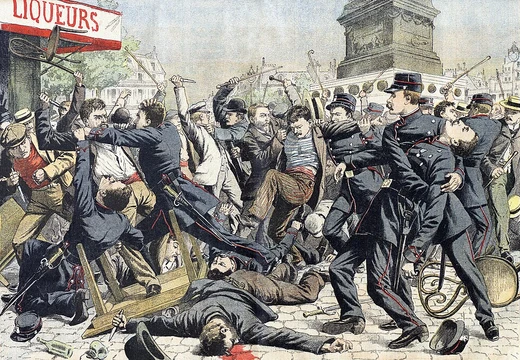
Among the most defining episodes of Dougherty's NYPD tenure was the 1912 murder of gambler Herman Rosenthal, shot dead outside the Hotel Metropole on July 16. District Attorney Charles S. Whitman publicly accused the police department of a sluggish response, yet singled out Dougherty as a rare exception, praising his willingness to cooperate directly with the prosecutor's office and commending his integrity. The investigation ultimately unraveled the Lenox Avenue Gang and led to the conviction and execution of NYPD Lieutenant Charles Becker. Dougherty's tenure at the department was far from smooth. A strict disciplinarian who kept tight control over his detectives, he repeatedly shook up the bureau's operations. He led aggressive raids on illegal gambling dens, once using axes to batter down doors, and arrested the crime boss Giosue Gallucci. In one dramatic sweep following a gunbattle that killed city court clerk Frederick Strauss, Dougherty commanded a squad that rounded up more than a hundred gang members within a single day. His two-and-a-half years at the NYPD ended in 1913, but the Rosenthal case cemented his reputation as a detective of uncommon courage and method.
Writer, Actor, and Adventurer: Life Beyond the Badge
After leaving the NYPD in 1913, Dougherty joined his brother Harry V. Dougherty in the family's private investigative firm, Dougherty's Detective Bureau and Mercantile Police, which had been established around the turn of the century. He also turned his considerable experience into print, publishing books such as A Word About Criminals in 1916 and The Criminal As A Human Being in 1924, alongside a steady stream of articles for the Saturday Evening Post and other periodicals. In 1914 he even stepped in front of a camera, appearing in the silent films Our Mutual Girl and The Line-Up at Police Headquarters. A windfall in 1921, when oil was discovered on Arizona land he owned, gave him the means to travel extensively abroad. During those years he spent time with Arthur Conan Doyle, the creator of Sherlock Holmes, and carried out a commission to sell an art collection valued at one million dollars. In 1923 he returned to policing in a teaching capacity, instructing at the detective school run by Commissioner Richard Edward Enright, with a particular focus on foreign police systems. In his final years he also voiced controversial positions, including advocating the whipping post for first-time offenders and federal legislation to ban the revolver.
Death and Enduring Legacy
George Samuel Dougherty's life ended on the evening of July 16, 1931, at his residence on 165th Street in Flushing, Queens, where he succumbed to cancer. His funeral was held at the family home two days later, and he was interred at Cypress Hills Cemetery. Throughout his career he had been regarded as one of the foremost detectives in the United States, a reputation that extended well beyond American borders. Across Europe he was recognized as a leading figure in the world of criminal investigation. His written legacy endures through three published books and a dozen or more articles spanning topics from the mechanics of shadowing suspects to the inner workings of night-club racketeers and the recovery of a million-dollar art masterpiece. His bibliography, which includes pieces in the Saturday Evening Post, Detective Magazine, and True Detective Mysteries, offers a window into the investigative thinking of an era when detective work was still being codified. From his early days as a printer in Cressona to his final years as a police instructor, Dougherty left an imprint on American law enforcement that outlasted his own lifetime.
Frequently Asked Questions
Who is Charles Whitman?
Charles Joseph Whitman was an American former U.S. Marine and architectural engineering student at the University of Texas at Austin. He is best known as the perpetrator of the 1966 UT tower shooting.
What is Charles Whitman known for?
He carried out the 1966 University of Texas tower shooting, which stands as one of the first mass shootings in modern American history to receive broad national media coverage.
How many people did Charles Whitman kill?
Whitman killed 18 people in total: his mother and wife, whom he stabbed the night before the tower attack, and 16 additional victims (including an unborn child) during the August 1, 1966 shooting spree. He also wounded 31 others.
How did Charles Whitman die?
He was shot and killed by a police officer while positioned in the University of Texas tower on the evening of August 1, 1966.
Why is Charles Whitman historically significant?
His attack is widely regarded as a landmark event in the history of American mass violence, as it was among the first such incidents to generate sustained national news coverage and public discourse.
More in Notorious Criminals And Gangsters 1-24
Spotted an error? Know more?
This is a living reference — every entry is fact-audited, and reader corrections feed straight into our audit queue. Suggest an edit · See this site's audit record